
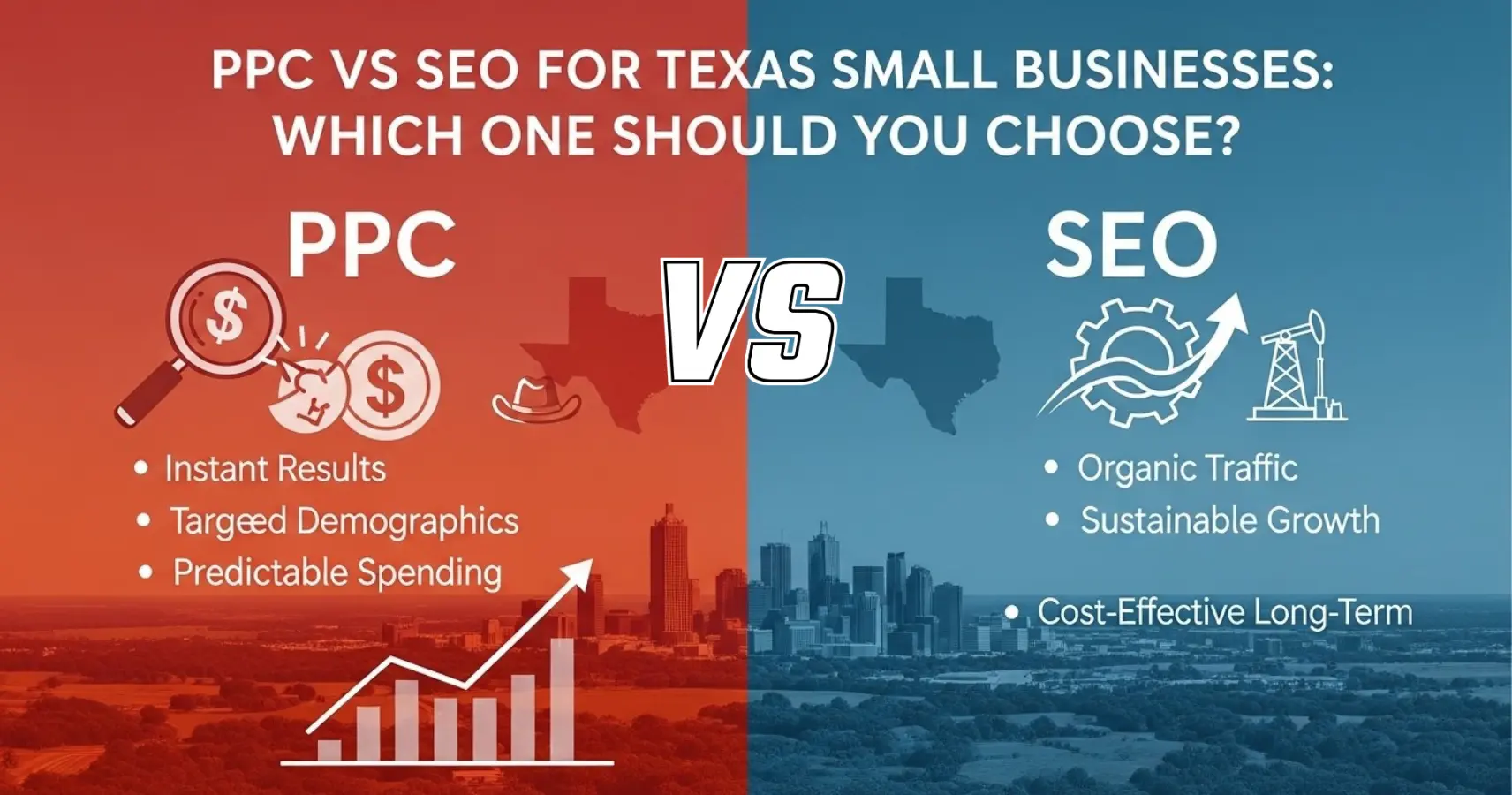
If you run a small business in Texas — whether it’s a BBQ joint in Austin, a boutique in Dallas, or a plumbing company in Houston — you’ve probably asked yourself: should I invest in PPC or SEO? Both are powerful digital marketing strategies, but they work very differently. Understanding the PPC vs SEO debate is essential for making smart decisions about your marketing budget.
In this guide, we’ll break down what each strategy means, how they compare, and help you figure out which one — or which combination — is right for your Texas small business.
What Is PPC? A Quick Overview
PPC (Pay-Per-Click) advertising means you pay every time someone clicks on your ad. The most common platform is Google Ads, where your business appears at the top of search results with a “Sponsored” label. You can also run PPC campaigns on Facebook, Instagram, and Bing.
Key characteristics of PPC for Texas small businesses:
- Immediate visibility — your ads can go live within hours
- You set a daily or monthly budget that you control
- You only pay when someone actually clicks your ad
- Results stop the moment you pause spending
- Great for targeting local Texas ZIP codes, cities, or regions.
For example, a San Antonio HVAC company can run a Google Ad targeting “AC repair near me” and start getting calls within the same day.
What Is SEO? A Quick Overview
SEO (Search Engine Optimization) is the process of improving your website so it ranks higher in organic (unpaid) search results. When someone searches “best tacos in Fort Worth,” the businesses that show up without a “Sponsored” tag are there because of strong SEO.
Key characteristics of SEO for Texas small businesses:
- Results build gradually over weeks or months
- No cost per click — organic traffic is free once you rank
- Focuses on content, keywords, backlinks, and technical site health
- Long-term results that keep working even when you’re not actively spending
- Builds credibility and trust with local Texas consumers
A well-optimized website for a Houston law firm, for instance, can generate consistent leads for years without ongoing ad spend.
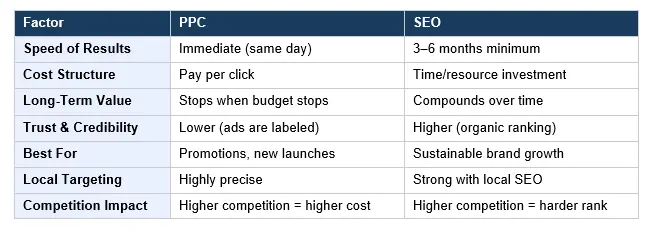
PPC vs SEO: A Side-by-Side Comparison
Here’s a clear breakdown to help Texas small business owners understand the core differences:
When Should a Texas Small Business Choose PPC?
PPC is your best bet in these situations:
- You need leads fast — maybe you just opened a new location in Dallas or launched a seasonal promotion
- You’re running a time-sensitive campaign (holiday sale, limited-time offer, event)
- Your industry is highly competitive and SEO would take too long to deliver ROI
- You want to test which keywords convert before investing heavily in SEO content
- You have a defined budget and want predictable, measurable results
Texas is one of the most competitive small business markets in the country. In cities like Houston, Austin, and Dallas, PPC can give you an immediate edge over local competitors by placing your business at the very top of search results
Not Sure Which Strategy Fits Your Texas Business? Get a Personalized Recommendation.
When Should a Texas Small Business Choose SEO?
SEO is the smarter long-term play when:
- You want to build sustainable organic traffic that doesn’t depend on ad spend
- Your business operates in a niche with specific local search intent (e.g., “orthodontist in Plano TX”)
- You’re focused on brand reputation and want to appear as a trusted authority in your field
- You have content to share — blogs, guides, FAQs — that can rank on Google
- Your margins are tight and you can’t afford ongoing PPC costs
Local SEO is especially powerful for Texas small businesses. Optimizing your Google Business Profile, earning local reviews, and building location-specific content can drive highly targeted traffic from nearby customers searching for exactly what you offer.
Can You Use Both PPC and SEO Together?
Absolutely — and for many Texas small businesses, a combined PPC vs SEO strategy is the most effective approach. Here’s why:
- PPC generates immediate traffic while your SEO strategy builds momentum
- SEO data helps refine your PPC keyword targeting and ad messaging
- Dominating both paid and organic results increases your brand’s click-through rate (CTR) significantly
- You can use PPC to promote high-value pages while organically ranking for broader terms
Think of it this way: PPC is the sprint, SEO is the marathon. The smartest Texas small businesses run both races at the same time, allocating budget strategically based on goals and seasonality.
Budget Considerations for Texas Small Businesses
Your budget will heavily influence the PPC vs SEO decision. Here’s a general guide:
- Under $500/month: Focus on SEO — create quality content, optimize your Google Business Profile, and build local citations
- $500–$1,500/month: Run a small PPC campaign for high-intent keywords while building SEO foundations
- $1,500–$5,000/month: Combine both strategies with dedicated content creation and targeted PPC campaigns
- $5,000+/month: Full-funnel digital marketing with aggressive SEO, PPC, retargeting, and conversion optimization
Keep in mind that PPC costs in Texas vary by industry. Legal, financial, and medical keywords can run $10–$50+ per click in competitive Texas markets, while local service businesses may find opportunities at $2–$8 per click.
Boosting Your CTR: Tips for Both Strategies
Whether you choose PPC vs SEO or both, improving your click-through rate (CTR) should always be a priority:
For PPC:
- Write compelling ad headlines that include your target keyword
- Use ad extensions (call extensions, location extensions, site links)
- Include a clear call-to-action like “Get a Free Quote Today”
- A/B test different ad copy variations regularly
For SEO:
- Write meta titles and descriptions that are specific, benefit-driven, and include your keyword
- Use numbers and power words in title tags (e.g., “7 Proven Tips…”)
- Add schema markup so your listing shows star ratings or FAQs in search results
- Keep your URLs short, clean, and keyword-rich
The Bottom Line: PPC vs SEO for Your Texas Business
There’s no single right answer in the PPC vs SEO debate — it truly depends on your business goals, budget, timeline, and competitive landscape. If you need results now, PPC delivers speed. If you’re building for the future, SEO builds lasting authority. And if you want to dominate your local Texas market, a smart combination of both is your strongest move.
Texas is a big, competitive state — but that also means there’s enormous opportunity for small businesses that invest in the right digital marketing strategy. Don’t let your competitors capture the clicks, leads, and customers that should be yours.