
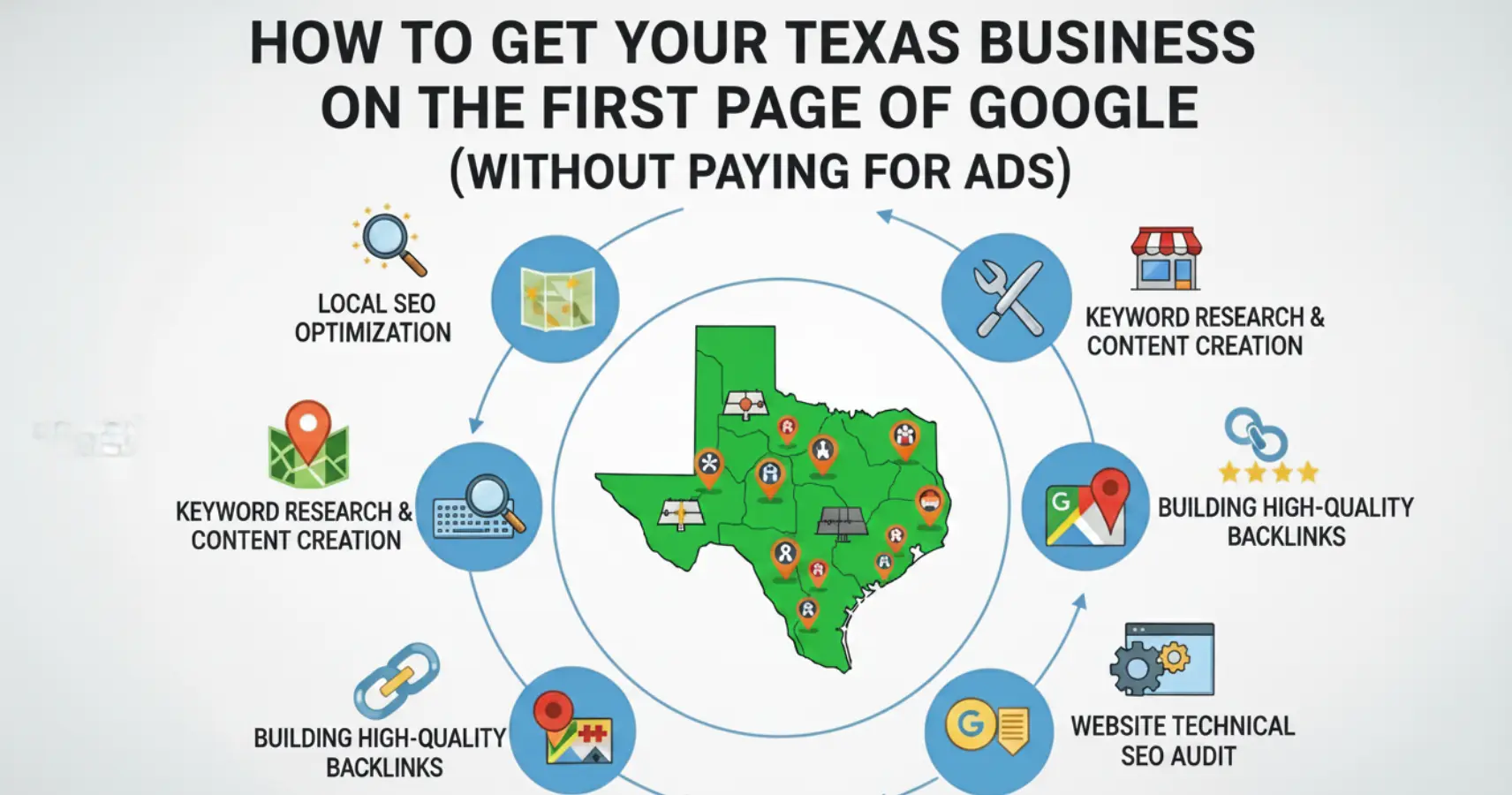
If you own a business in Texas and you’re not showing up on the first page of Google, you’re essentially invisible to thousands of potential customers searching for exactly what you offer — right now. The good news? You don’t need a massive advertising budget to compete online. With the right local SEO strategies, getting your Texas business on the first page of Google organically is not only possible — it’s achievable faster than most business owners think.
In this guide, we’ll walk you through every proven tactic to rank your first page Google Texas business listing organically — for free
Why the First Page of Google Is a Game-Changer for Texas Businesses
Research consistently shows that over 90% of searchers never go beyond page one of Google results. That means if your Texas business isn’t appearing on that coveted first page, your competitors are taking all the clicks, calls, and customers.
Texas is home to over 3 million small businesses. The competition is fierce — but the local SEO opportunity is massive. Cities like Houston, Dallas, Austin, San Antonio, and Fort Worth have millions of residents searching Google every single day for local services. Capturing even a fraction of that search traffic can transform your business.
Step 1: Claim and Fully Optimize Your Google Business Profile
Your Google Business Profile (GBP) is the single most powerful free tool for getting your first page Google Texas business ranking. This is the listing that appears in Google Maps and the Local Pack (the top three business results on Google).
Here’s how to optimize it:
- Claim your profile at business.google.com and verify ownership via phone or postcard.
- Fill in every single field — business name, address, phone number, website, hours, and services.
- Write a keyword-rich business description that naturally includes terms like ‘Texas business,’ your city name, and your core service.
- Choose the most accurate primary and secondary categories for your business.
- Upload high-quality photos of your location, products, team, and storefront.
- Post weekly Google Business updates to signal activity to the algorithm.
- Actively collect and respond to every Google review — both positive and negative.
Google reviews are critical ranking signals. Businesses with consistent, recent five-star reviews dramatically outrank competitors in Texas local search results. Ask every satisfied customer to leave a review — and make it easy with a direct review link.
Step 2: Build a Location-Optimized Website
Your website is your most important owned asset for organic ranking. To achieve a first page Google Texas business ranking, your website must clearly signal to Google who you serve and where.
On-Page SEO Essentials for Texas Businesses:
- Include your city and state in your homepage title tag — e.g., ‘Best HVAC Services in Dallas, TX’.
- Use location-based keywords naturally throughout your homepage, about page, and service pages.
- Add your full business Name, Address, and Phone Number (NAP) in the footer of every page.
- Create individual landing pages for each city or service area you cover in Texas.
- Write unique, helpful content on each page — Google penalizes duplicate and thin content.
- Optimize your meta descriptions to include Texas-specific keywords and a clear call to action.
- Embed a Google Map on your contact page to reinforce your local presence.
Step 3: Get Listed in Local Directories and Citations
Local citations — mentions of your business name, address, and phone number on other websites — are a major ranking factor for local SEO. Consistent citations signal to Google that your Texas business is legitimate and well-established.
Top Directories Every Texas Business Must Be Listed In:
- Yelp — Yelp listings often appear on the first page of Google for local business searches.
- Bing Places for Business — Microsoft’s search engine has significant market share in the USA.
- Apple Maps — Essential for iPhone users searching for businesses near them.
- Better Business Bureau (BBB) — Builds trust and provides a powerful local backlink.
- Angi (formerly Angie’s List) — Especially important for home service businesses in Texas.
- Nextdoor — Hyper-local neighborhood platform, perfect for Texas community-based businesses.
- Facebook Business Page — Social signals and citations help Google validate your business.
- Texas-specific directories and your local Chamber of Commerce website.
Ready to Rank #1 in Your Local Market?
Step 4: Create High-Value Content Targeting Texas Search Queries
Content is what drives organic Google rankings — and for Texas businesses, locally relevant content is gold. A well-written blog post answering a common question from Houston homeowners can pull consistent free traffic for years.
Content ideas for Texas local businesses:
- ‘Best [Service] in [Texas City] — What to Look For in 2025’
- ‘How Much Does [Service] Cost in Texas?’
- ‘Top 10 Questions Texas Homeowners Ask About [Your Industry]’
- ‘[Your City], TX [Season] Guide: Tips from a Local [Business Type]’
- FAQ pages that answer the exact questions your Texas customers type into Google.
Step 5: Earn Backlinks from Trusted Texas Sources
Backlinks — links from other websites to yours — are one of Google’s top three ranking factors. For local SEO in Texas, backlinks from local and relevant sources carry enormous weight.
Free ways to earn quality backlinks as a Texas business:
- Join your local Texas Chamber of Commerce — most provide a backlink on their member directory.
- Sponsor local Texas events, charity drives, or school programs — sponsors often get listed on event websites.
- Reach out to local Texas bloggers, news sites, and community websites for feature stories.
- Partner with complementary local businesses for mutual website mentions.
- Submit guest blog posts to Texas-focused industry publications.
Get featured in local Texas news outlets like Texas Tribune, Community Impact, or city-specific news blogs.
Step 6: Technical SEO — The Foundation You Can't Ignore
Even the best content and backlinks won’t save a technically broken website. Google evaluates the technical health of your website before deciding whether to rank it for first page Google Texas business searches.
- Mobile-First: Over 60% of Google searches in Texas are done on smartphones. Your site must be fully mobile-responsive.
- Page Speed: Google’s Core Web Vitals measure load speed. Use Google PageSpeed Insights to check and fix issues.
- HTTPS Security: Google gives ranking preference to secure (HTTPS) websites. Get an SSL certificate if you don’t have one.
- Fix Broken Links: Crawl your site with free tools like Screaming Frog or Ahrefs Webmaster Tools to find and fix broken links.
- Schema Markup: Add LocalBusiness structured data to your website to help Google better understand your business details.
XML Sitemap: Submit a sitemap to Google Search Console so Google can efficiently crawl and index your Texas business pages
Step 7: Track Your Rankings and Double Down on What Works
Getting your Texas business to rank on page one is only the beginning. Maintaining and improving your rankings requires consistent monitoring and optimization.
Free tools to monitor your SEO progress:
- Google Search Console — See exactly which keywords bring visitors to your Texas business website and how you rank for each.
- Google Analytics 4 — Understand where your traffic comes from and which pages convert visitors into customers.
- Google Business Profile Insights — Track how many people found your profile, called your business, or asked for directions.
- Ahrefs Webmaster Tools (Free) — Monitor backlinks and spot technical SEO issues.
- BrightLocal — Specifically designed for local SEO tracking, including Google Maps rank tracking for Texas cities.
Important expectation: Local SEO is not instant. Most Texas businesses begin to see meaningful movement in their Google rankings within 3 to 6 months of consistent effort. The businesses that commit to the process long-term are the ones that dominate their local markets for years
Your 30-Day Action Plan to Start Ranking on Page One
Here’s a quick-start checklist to kick off your journey to a first page Google Texas business ranking:
- Week 1: Claim and fully optimize your Google Business Profile. Collect your first 5 reviews.
- Week 2: Audit and optimize your website’s on-page SEO — title tags, meta descriptions, NAP, and city pages.
- Week 3: Submit your business to 10+ local directories and ensure NAP consistency everywhere.
- Week 4: Publish your first piece of Texas-focused content and begin outreach for your first local backlink.
The businesses dominating the first page of Google in Texas today didn’t get there by accident — and they didn’t all pay for ads. They got there by consistently applying the exact strategies outlined in this guide. Your Texas business can do the same.
Start with your Google Business Profile today. One step at a time, your first page Google Texas business listing is well within reach — without spending a single dollar on ads.