
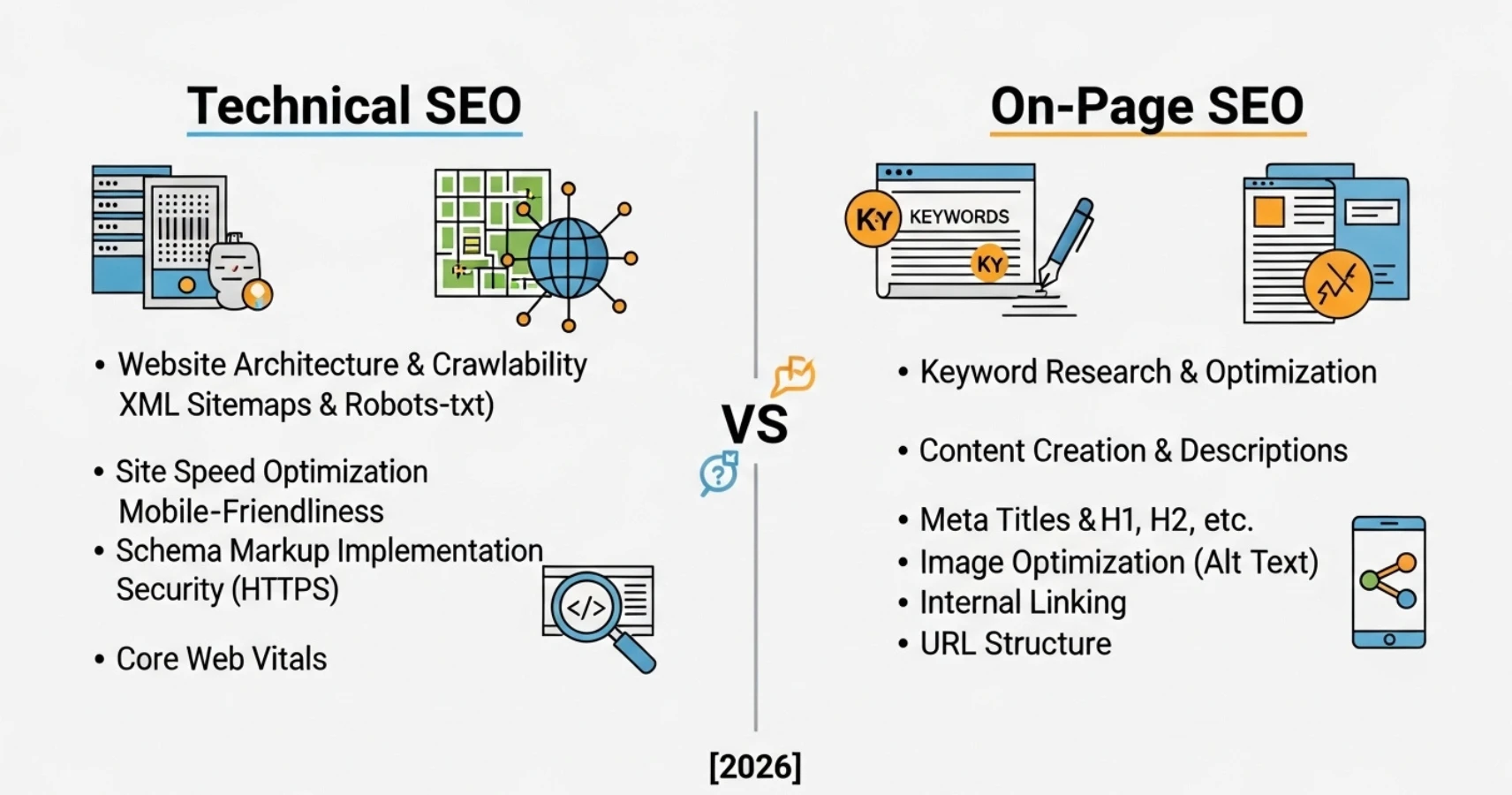
If you have ever Googled your business in India and wondered why a competitor ranks above you, the answer often comes down to one thing — SEO. But SEO is not a single tactic. It is a combination of strategies, and two of the most important are technical SEO vs on-page SEO.
Many Indian businesses, from startups in Bengaluru to e-commerce brands in Delhi and service providers in Mumbai, invest in SEO without truly understanding the difference between these two pillars. The result? Time and money wasted on strategies that don’t work together.
In this guide, we’ll break down technical SEO vs on-page SEO in plain English, explain what each covers, compare them side by side, and help you decide which to prioritize first — especially if you’re targeting Indian audiences on Google in 2026
What Is On-Page SEO?
On-page SEO refers to all the optimizations you make directly on your web pages to help search engines understand your content and to give users a great experience. Unlike off-page SEO (which deals with backlinks from other sites), on-page SEO is entirely within your control.
On-page SEO covers elements that are visible on the page — content, keywords, headings, images — as well as some behind-the-scenes HTML elements like title tags and meta descriptions.
Key On-Page SEO Elements:
- Keyword research and strategic keyword placement (title, H1, H2s, body content)
- Title tags and meta descriptions — your first impression on Google SERPs
- Header structure (H1, H2, H3) for content hierarchy
- High-quality, helpful, and E-E-A-T aligned content
- Image optimization with descriptive alt text and compressed file sizes
- Internal linking to related pages on your site
- URL structure — short, descriptive, and keyword-rich
- Content length, readability, and formatting
For Indian businesses, on-page SEO also means aligning content with local user intent. A user in Jaipur searching for “affordable web design services” has different expectations than someone in Mumbai — your content should reflect that.
Stop Losing Customers to Your Competitors!
What Is Technical SEO?
Technical SEO refers to the behind-the-scenes optimizations that ensure search engines can crawl, index, and rank your website efficiently. Think of it as the infrastructure of your website — if the foundation is cracked, even the best content won’t perform.
In India, where over 70% of internet users browse on mobile devices and network speeds vary significantly across cities and rural areas, technical SEO is not optional — it is a competitive necessity.
Key Technical SEO Elements:
- Site speed and Core Web Vitals (LCP, FID, CLS) — critical for Indian mobile users
- Mobile-first indexing — Google prioritizes your mobile site for ranking
- Crawlability — ensuring Googlebot can access and read all your pages
- XML sitemaps and robots.txt configuration
- HTTPS / SSL security — a basic Google ranking signal
- Structured data and schema markup (for AI Overviews and rich results)
- Fixing broken links, redirect chains, and 404 errors
- Canonical tags to avoid duplicate content issues
Technical SEO acts as the foundation on which all other SEO efforts are built. Without it, even perfectly optimized on-page content may fail to rank — because Google simply cannot access or understand your site properly.
Technical SEO vs On-Page SEO: Side-by-Side Comparison
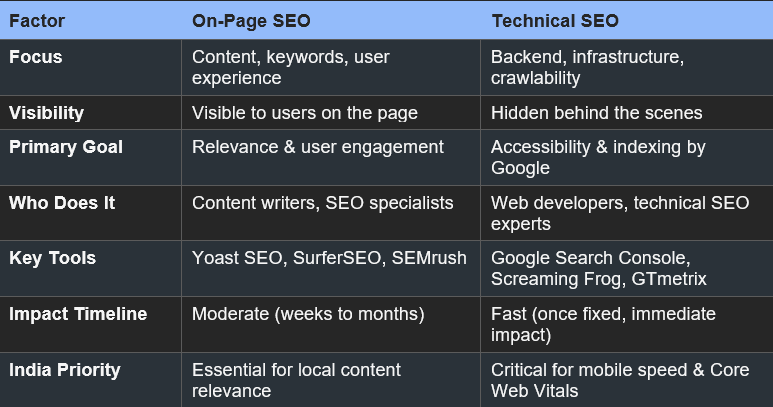
Key Differences Between Technical SEO and On-Page SEO
The most important distinction when comparing technical SEO vs on-page SEO is this: technical SEO makes your site accessible to search engines, while on-page SEO makes your content relevant and valuable to both users and search engines.
Here’s a simple analogy: imagine your website is a physical store in Connaught Place, Delhi. Technical SEO is the building — the roads leading to it, the electricity, the signage that helps customers find you. On-page SEO is the interior — the products on display, the labels, the layout that keeps customers browsing and buying.
Without a proper building (technical SEO), no one can enter your store. Without good interior design (on-page SEO), visitors walk out without purchasing. You need both to succeed.
Common Mistakes Indian Businesses Make
When it comes to technical SEO vs on-page SEO, many Indian businesses fall into predictable traps:
- Focusing only on keywords — writing keyword-stuffed content while the site loads in 8+ seconds on mobile.
- Ignoring mobile speed — India has 750+ million smartphone users; a slow mobile site loses rankings fast.
- Skipping schema markup — missing out on Google’s rich results and AI Overviews by not adding structured data.
- Treating SEO as a one-time task — both technical and on-page SEO require continuous updates as Google algorithms evolve.
- Publishing content without technical fixes — no amount of great blog posts will rank if your site has crawl errors or indexing issues
Which Should You Prioritize First? A Guide for Indian Businesses
When choosing between technical SEO vs on-page SEO, the recommended priority order for most Indian businesses is:
- Fix Technical SEO First — Ensure Google can crawl and index your site. Fix broken links, slow page speed, and mobile issues before anything else.
- Then Optimize On-Page SEO — Once the foundation is solid, create keyword-optimized, high-quality content aligned with user intent.
- Run Both in Parallel — For established sites, work on both simultaneously with dedicated resources for each.
For Indian startups and SMBs with limited budgets, start with a free technical SEO audit using Google Search Console. Fix critical errors first — especially mobile usability and Core Web Vitals — then layer your on-page SEO strategy on top.
Best Tools for Technical SEO and On-Page SEO in India
For Technical SEO:
- Google Search Console (Free) — track indexing, crawl errors, and Core Web Vitals
- Screaming Frog SEO Spider — in-depth technical audits
- GTmetrix / PageSpeed Insights — site speed analysis for Indian servers
- Ahrefs Site Audit — comprehensive technical health checks
For On-Page SEO:
- Google Keyword Planner (Free) — keyword research for India-specific search volumes
- Yoast SEO / Rank Math — on-page optimization plugins for WordPress
- SurferSEO — content optimization aligned with top-ranking pages
- SEMrush / Ahrefs — competitor content analysis and keyword gap research
How Technical SEO and On-Page SEO Work Together
The real power in SEO comes not from choosing between technical SEO vs on-page SEO, but from combining them into one cohesive strategy. Here is how they complement each other:
- A fast, mobile-optimized site (technical SEO) paired with helpful, keyword-rich content (on-page SEO) signals both quality and relevance to Google.
- Schema markup (technical SEO) enhances on-page content by helping Google display rich snippets and AI Overview citations.
- A well-structured internal linking strategy (on-page SEO) helps Googlebot crawl your site more efficiently (technical SEO benefit).
- Fixing duplicate content with canonical tags (technical SEO) ensures your best on-page content gets full ranking credit.
In 2026, with Google’s AI-powered search results (SGE/AI Overviews) increasingly dominant in Indian SERPs, the combination of structured technical health and well-optimized, authoritative on-page content is what determines whether your page gets cited — or ignored.
Conclusion
The debate around technical SEO vs on-page SEO is ultimately a false choice. In 2026, especially in India’s highly competitive and mobile-dominant search environment, ranking on Google Page 1 requires both working in harmony.
Start with a technical SEO audit to ensure Google can access and understand your site. Then build and optimize your on-page content with the right keywords, structure, and intent alignment. Do both consistently, and you create a compounding SEO advantage that outpaces competitors who are doing only one or the other.
Whether you’re a growing startup in Hyderabad, a D2C brand in Pune, or a local service provider in Chandigarh — the formula is the same: fix your technical foundation first, then let your content do the talking.
Is technical SEO or on-page SEO more important?
Both are essential, but technical SEO should be fixed first. Think of it this way — on-page SEO is the message, and technical SEO is the vehicle that delivers it. Without a working vehicle, your message never reaches its destination
Can on-page SEO work without technical SEO?
Partially. Great content may earn some traffic, but without proper technical SEO — fast load times, mobile optimization, correct indexing — your rankings will be significantly limited. In India's mobile-first environment especially, technical issues can completely block ranking potential.
How long does it take to see results from technical SEO vs on-page SEO in India?
Technical SEO fixes (like resolving crawl errors) can show results within days to weeks. On-page SEO improvements — especially new content — typically take 2 to 6 months to reflect in rankings, depending on competition and domain authority.
What is the difference between technical SEO and on-page SEO in simple terms?
On-page SEO is what your visitors see and read on your page — content, keywords, headings. Technical SEO is what Google sees under the hood — speed, structure, crawlability. Both need to be strong for you to rank