
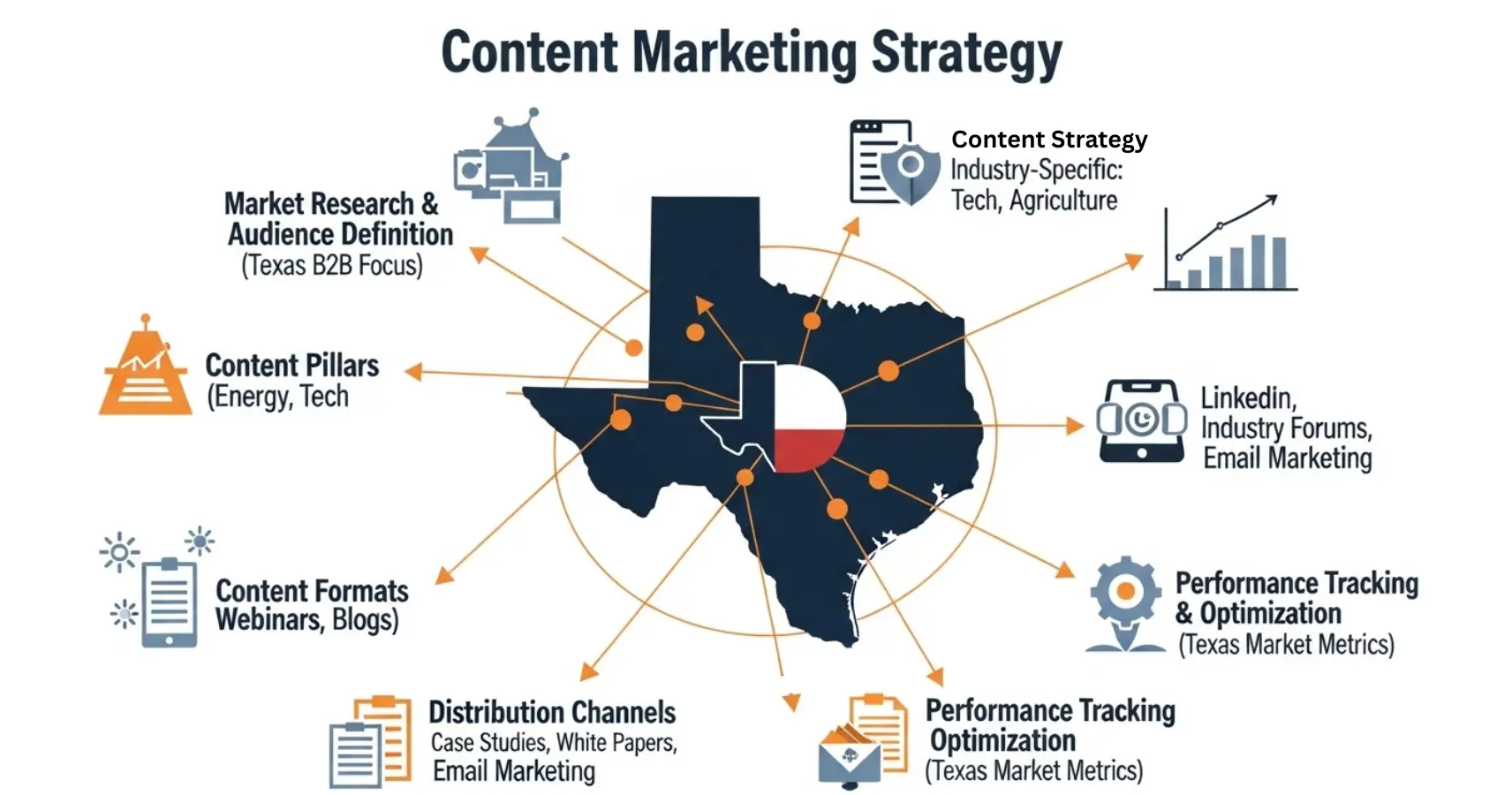
The digital landscape has shifted dramatically, and content marketing Texas B2B professionals can no longer rely on outdated playbooks. In 2026, artificial intelligence is rewriting how buyers discover, evaluate, and trust vendors — and Texas B2B companies that fail to adapt risk being invisible to their most valuable prospects. Whether you are a SaaS startup in Austin, a logistics firm in Houston, or a professional services company in Dallas, a sharp, data-driven content strategy is your competitive advantage.
This guide breaks down a practical, results-focused content marketing strategy built specifically for the Texas B2B market in 2026 — one designed to increase organic traffic, generate quality leads, and position your brand as the authority in your industry
Why Content Marketing is Critical for Texas B2B in 2026
Texas is one of the fastest-growing business ecosystems in the United States. With over 3 million small and mid-size businesses and a thriving enterprise sector, competition for B2B buyer attention is fiercer than ever. Content marketing Texas B2B companies invest in is no longer a nice-to-have — it is the engine that powers pipeline.
In 2026, the rise of Generative Engine Optimization (GEO) has transformed how companies appear in AI-driven search results on platforms like ChatGPT, Google AI Overviews, Perplexity, and Bing Copilot. Traditional keyword strategies alone are no longer sufficient. B2B buyers are now getting answers directly from AI — and the brands that inform those answers are the ones that win the deals.
For Texas B2B organizations, this means one thing: building content ecosystems that are authoritative, structured, and AI-readable
Step 1: Define Your Texas B2B Audience with Precision
Effective content marketing Texas B2B campaigns begin with an obsessive understanding of your buyer personas. Texas B2B buyers vary widely — from oil and gas procurement directors in Midland to tech decision-makers in the Silicon Hills of Austin. Generic content will not move the needle.
- Map the full buying committee — not just the decision-maker.
- Identify the 3–5 core business pain points unique to your Texas niche.
- Conduct quarterly voice-of-customer research — interviews, sales call reviews, and Gong data analysis.
- Use regional language and references that resonate with Texas business culture.
The more precisely you define your audience, the more efficiently your content budget converts into pipeline.
Step 2: Build a Topic Cluster Strategy Around Texas B2B Pain Points
Search engines and AI models reward topical authority over isolated keyword optimization. For content marketing Texas B2B success, structure your content around interconnected topic clusters:
- Pillar Pages: Comprehensive, 2,500–4,000-word guides on broad Texas B2B topics (e.g., “B2B Lead Generation in Texas”).
- Cluster Content: Supporting blogs, FAQs, case studies, and comparison pages that link back to the pillar.
- GEO-optimized Pages: Content specifically formatted to be cited by AI engines — featuring structured data, clear definitions, and direct answers to buyer questions.
This architecture signals authority to both Google’s algorithms and AI language models, ensuring your brand surfaces when Texas B2B buyers seek answers — wherever they’re searching.
Step 3: Prioritize High-Intent Content Formats That Drive Conversions
Not all content formats deliver the same ROI for Texas B2B companies. In 2026, these are the highest-impact formats your content marketing Texas B2B strategy must include:
- Long-form SEO blogs (1,000–2,500 words): Still a cornerstone of organic traffic. Target informational and commercial-intent keywords relevant to your Texas industry vertical.
- Case Studies: Nothing converts Texas B2B prospects faster than proven results from businesses they relate to. Localize your case studies — “How a Dallas SaaS Firm Cut CAC by 40% with Content Marketing” outperforms generic ones every time.
- Video Content & Webinars: Texas B2B buyers, especially in enterprise sectors, consume video heavily. Short-form educational videos, LinkedIn Lives, and recorded webinars build trust at scale.
- LinkedIn Thought Leadership: Texas has a powerful LinkedIn B2B community. Executive-authored posts and company page content drive awareness and inbound inquiries.
- AI-Cited FAQ Pages: Structured, question-and-answer formatted content that positions your brand as a knowledge source for AI-generated responses.
A well-mixed content calendar that rotates these formats ensures consistent engagement across the full buyer journey — from first discovery to final decision.
Your competitors are already investing in AI search. Are you?
Step 4: Integrate GEO Into Your Texas B2B Content Strategy
Generative Engine Optimization (GEO) is the defining content marketing frontier of 2026. Studies show that over 40% of B2B research now begins with an AI-powered search query. For content marketing Texas B2B professionals, GEO is not optional — it is urgent.
To optimize your content for AI engines:
- Write direct, declarative answers early in each piece of content.
- Implement schema markup (FAQ, HowTo, Article) across your site.
- Build content around entity-based SEO — people, places, brands, and concepts your Texas B2B audience cares about.
- Earn citations from trusted industry publications, Texas business journals, and partner websites.
- Build E-E-A-T signals: demonstrate Experience, Expertise, Authoritativeness, and Trustworthiness in every piece of content.
Texas B2B companies that embrace GEO today will dominate AI search results tomorrow — leaving competitors scrambling to catch up.
Step 5: Measure What Matters — B2B Content Marketing KPIs for 2026
Smart Texas B2B marketers do not just track vanity metrics. Your content marketing Texas B2B program needs to demonstrate clear revenue impact. Track these KPIs monthly:
- Organic traffic growth segmented by content type and topic cluster
- Content-attributed MQL (Marketing Qualified Lead) volume
- AI search citation frequency (how often your brand appears in AI-generated answers)
- Time-to-close for content-influenced deals vs. non-content-influenced deals
- Content engagement rate: scroll depth, time on page, and return visitor rate
Tie these metrics to CRM data so leadership sees content marketing as a revenue driver — not a cost center. Texas B2B companies that prove content ROI retain executive buy-in and budget to scale.
Texas B2B Content Marketing Trends to Watch in 2026
Staying ahead in content marketing Texas B2B means anticipating where the market is heading, not chasing where it has been. The top trends shaping the Texas B2B content landscape in 2026 include:
- AI-Assisted Content Production: Texas B2B marketers using AI tools for research, drafting, and optimization produce 3x more content at 60% lower cost — without sacrificing quality when guided by human strategy.
- Hyper-Local Content Hubs: City and industry-specific landing pages (“B2B Marketing Solutions in San Antonio”) capture local search intent that broad content misses.
- Interactive Content: Calculators, assessments, and configurators keep Texas B2B prospects on your site longer and generate higher-quality lead data.
- Podcast & Audio Content: Texas executives increasingly consume content during commutes. Branded podcasts and audio content establish thought leadership in a low-competition channel.
Brands that experiment with these formats now will build audience loyalty and compounding SEO and GEO advantages that are nearly impossible to replicate later.
Final Thoughts: Content Marketing is a Long Game — Start Running Now
The Texas B2B market is massive, competitive, and increasingly driven by digital-first buyer behavior. Content marketing Texas B2B strategy in 2026 is not just about blog posts and keyword rankings — it is about owning the entire information journey your buyers take before they ever speak to your sales team.
When you combine audience precision, topic cluster authority, high-intent content formats, GEO optimization, and data-driven measurement, you build a content marketing machine that delivers compounding returns year after year. Your competitors are still figuring this out — which makes right now the single best moment to accelerate.