
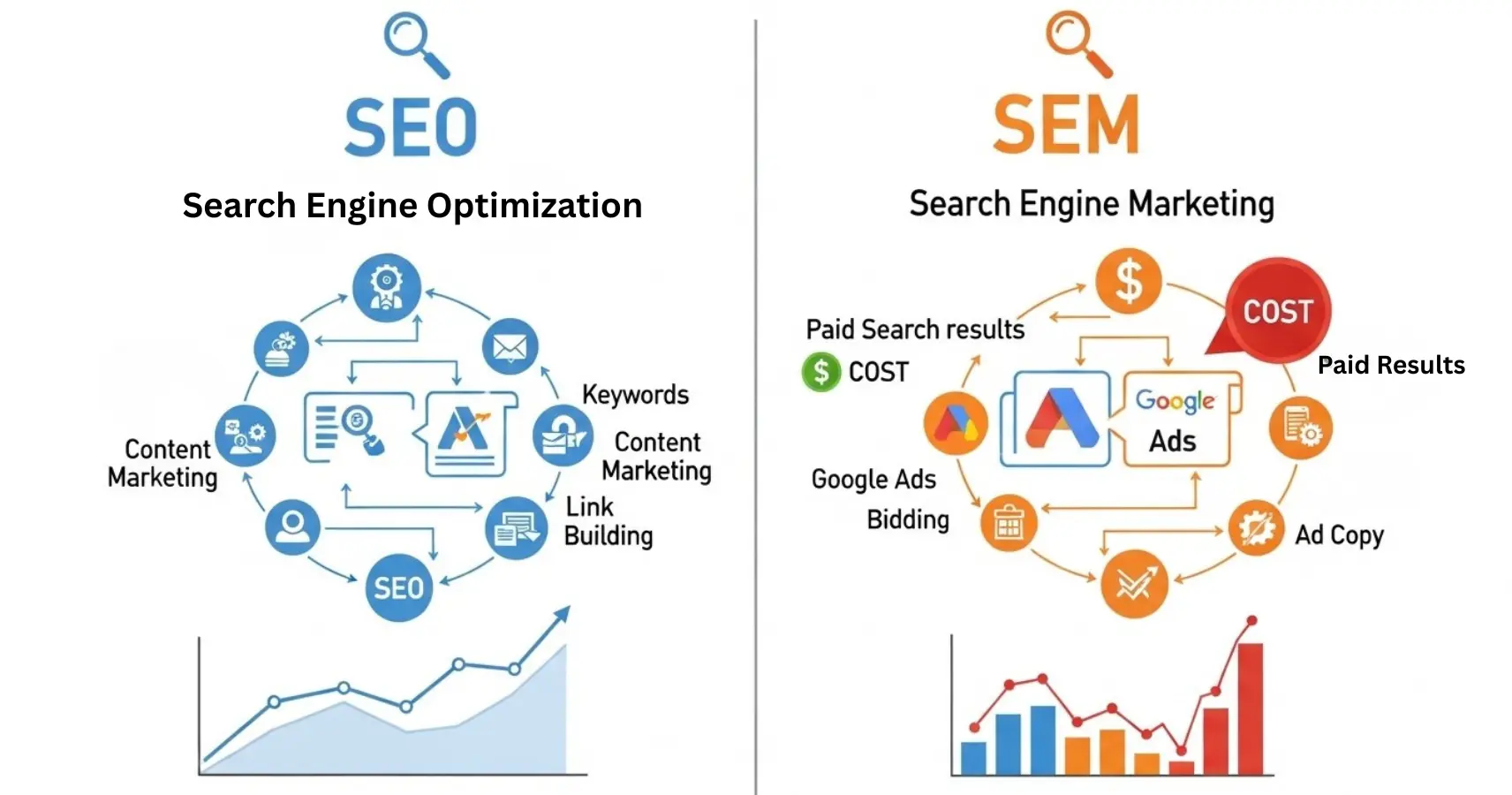
If you’ve ever searched “SEO vs SEM” and walked away more confused than before, you’re not alone. These two terms are often used interchangeably — but they’re fundamentally different strategies. Choosing the wrong one (or ignoring one entirely) can cost your US business thousands of dollars and months of wasted effort.
In this guide, we break down exactly what SEO and SEM mean in 2026, how they differ, what they cost, and — most importantly — which one is right for your business goals right now.
What Is SEO? (Search Engine Optimization)
SEO is the process of optimizing your website to rank organically (without paying for ads) in search engine results pages (SERPs). When someone in the US searches best CRM software for small business and clicks a non-ad result — that’s SEO working in action.
SEO includes three core pillars:
- On-Page SEO — optimizing content, keywords, headings, and meta tags
- Off-Page SEO — building backlinks and domain authority through external signals
- Technical SEO — improving site speed, mobile-friendliness, crawlability, and structured data
The key benefit of SEO is compounding, long-term traffic. Once your content ranks, it continues driving visitors without ongoing ad spend. However, SEO is a long game — new websites in competitive US markets can take 3 to 6+ months to see meaningful results.
In 2026, SEO has evolved significantly. Google’s AI-powered algorithms now prioritize search intent, E-E-A-T (Experience, Expertise, Authoritativeness, Trustworthiness), and content quality over keyword stuffing. Only 22% of pages ever reach page one of Google — which makes smart SEO strategy more critical than ever.
What Is SEM? (Search Engine Marketing)
SEM refers to paid search advertising — primarily through Google Ads and Microsoft Advertising. When you see results labeled “Sponsored” at the top of Google, that’s SEM. You bid on keywords, and your ad appears instantly when users search for those terms.
SEM works through:
- Keyword bidding — you pay per click (PPC) when a user clicks your ad
- Ad auctions — Google ranks ads based on bid amount + Quality Score
- Targeting options — location, device, time of day, audience demographics
The average cost-per-click (CPC) on Google Ads in the US is $2.69, though competitive industries like legal, finance, and insurance can see CPCs of $50+. The average search CTR through SEM is around 3.17%.
The biggest SEM advantage? Speed. You can go from zero visibility to the top of Google’s SERP in under 48 hours. The moment your campaign goes live, your business is visible to high-intent searchers. The moment you pause spending? The traffic stops.
SEO vs SEM: Key Differences at a Glance
Here’s a quick side-by-side comparison to understand how SEO vs SEM stack up across the metrics that matter most for US businesses:
Factor | SEO (Organic) | SEM (Paid) |
Cost | Free clicks (time/resource investment) | Pay-per-click (avg. $2.69 CPC on Google Ads) |
Speed | 3–6+ months to see results | Instant — live in under 48 hours |
Sustainability | Long-term asset, traffic stays | Stops when budget runs out |
Control | Algorithm-dependent | Full control over targeting & budget |
CTR | ~94% prefer organic results | ~3.17% average Search CTR |
Best For | Brand authority, long-term ROI | Product launches, quick wins |
SEO vs SEM: Cost Breakdown for US Businesses
SEO Costs
SEO isn’t free — but it’s an investment in a long-term asset. Typical US SEO costs include:
- Freelance SEO specialist: $500–$3,000/month
- Agency SEO retainer: $1,500–$10,000+/month
- SEO tools (Ahrefs, SEMrush, Moz): $100–$500/month
The difference is that once you rank, clicks cost you nothing. A well-ranking blog post can drive thousands of monthly visitors indefinitely.
SEM Costs
SEM costs are directly tied to ad spend. Budget considerations for US businesses:
- Minimum viable Google Ads budget: $1,000–$2,000/month for competitive niches
- Average small business SEM spend: $9,000–$10,000/month
- Average Google Ads ROI: $2 in revenue for every $1 spent (Google’s own data)
The trade-off: SEM gives predictable, scalable results — but requires continuous investment.
Ready to Dominate Google Search in the USA?
Whether it’s organic SEO or paid SEM — We build strategies that drive real leads, not just traffic.
When Should You Choose SEO?
SEO is the right strategy when:
- You have time to invest — at least 6–12 months before expecting major results
- You’re building long-term brand authority in your US market
- Your industry has high search volume for informational or commercial keywords
- You run a content-heavy business — blog, SaaS, e-commerce, or educational site
- You want sustainable traffic that doesn’t evaporate when budgets tighten
Real-world example: A US-based SaaS company investing in SEO through in-depth blog content and link building can own their niche organically within 12–18 months — driving high-intent traffic at near-zero ongoing cost.
When Should You Choose SEM?
SEM is the right move when:
- You need traffic immediately — product launch, seasonal campaign, or new market entry
- Your website is brand new with zero organic authority
- You want to test messaging and offers before committing to long-term SEO content
- You’re targeting bottom-of-funnel users who are ready to buy right now
- Your business has a clear, measurable ROI model for paid spend
Real-world example: A local US law firm bidding on personal injury lawyer near me can appear at the top of Google instantly — capturing high-intent leads without waiting months for SEO to kick in.
SEO vs SEM: Can You Use Both Together?
Absolutely — and for most US businesses, a combined strategy delivers the best results.
Here’s why SEO and SEM work better together:
- SEM data reveals which keywords actually convert → feed those insights into your SEO content strategy
- SEO builds brand credibility → lowers your cost-per-click over time as Quality Scores improve
- SEM bridges the revenue gap while SEO authority matures
- Running both increases your total SERP real estate — users see you in both paid and organic results
Think of SEO as a marathon and SEM as a sprint. Smart US businesses run both races simultaneously — using SEM to win today while SEO builds momentum for tomorrow.
SEO vs SEM for Different US Business Types
Small & Local Businesses
Start with Local SEO (Google Business Profile, local citations) + targeted SEM for high-intent location-based keywords. Budget-conscious? Prioritize Local SEO first.
E-Commerce Stores
Use SEM for product launches and seasonal promotions. Use SEO for category pages, product descriptions, and content marketing that captures top-of-funnel shoppers.
B2B Companies
SEO dominates in B2B — buyers research extensively before contacting sales. Invest in long-form SEO content (guides, case studies, comparison pages) and use SEM for retargeting warm leads.
Startups
Start with SEM for fast market validation. Use the conversion data to build an SEO content roadmap. This prevents wasting months writing content for keywords that don’t convert.
SEO vs SEM Trends in 2026 You Must Know
The search landscape has shifted dramatically. Here’s what US marketers need to know right now:
- AI Overviews (SGE): Google’s AI-generated answers now appear for many informational queries, reducing click-through rates to traditional organic results. Optimize for featured snippets and structured data.
- AI-Powered Bidding in SEM: By 2026, 85% of Google Ads bidding is automated by machine learning. Your job is feeding the algorithm clean, high-quality audience data.
- Search Intent is King: Google’s algorithms now detect exact user intent. Content that mismatches intent — regardless of keyword density — will not rank.
- Generative Engine Optimization (GEO): A new discipline emerging alongside SEO — optimizing content for AI answer engines like ChatGPT and Perplexity. SEO + GEO will increasingly overlap.
- Voice & Visual Search: Growing in US markets — optimize for conversational long-tail keywords and image alt text.
Conclusion: SEO vs SEM — Which Should You Choose?
Here’s the honest answer: it depends on where your business is right now.
- Choose SEO if you’re building for the long term and have 6–12 months of patience
- Choose SEM if you need leads or sales now and have a clear ad budget
- Choose both if you want to dominate the US search landscape and outperform competitors
In 2026, the businesses winning in US search aren’t choosing between SEO vs SEM — they’re using SEO for compounding authority and SEM for precise, immediate market capture. Start with one, scale with both.
Can a small US business afford SEM?
Yes — with the right targeting. Even a $500–$1,000/month budget can generate meaningful results in local or niche markets if campaigns are well-optimized. Negative keyword lists alone can reduce wasted spend by up to 30%
How long does SEO take to work?
For competitive US markets, expect 3–6 months minimum for meaningful organic traction. New websites can take 6–12 months to rank on page one. The investment pays off over years, not weeks.
What's the difference between SEM and PPC?
PPC (Pay-Per-Click) is a pricing model. SEM is the broader strategy of paid search marketing, which typically uses PPC. All SEM involves PPC, but PPC can also extend to display and social advertising.
Is SEO better than SEM?
Neither is universally better. SEO offers long-term, sustainable growth with lower ongoing costs. SEM provides instant visibility and precise targeting. The best strategy depends on your timeline, budget, and business goals.